The 2 TiB Subnet Milestone & Enterprise Cloud Engines: Why 2026 Marks the Turning Point for On-Chain Storage
For over two decades, the global technology sector has operated under the unquestioned assumption that high-throughput storage and heavy application computation must reside inside centralized corporate server farms operated by Amazon Web Services, Microsoft Azure, or Google Cloud. The dramatic expansion of Internet Computer subnets to 2 TiB of replicated state, coupled with DFINITY's rollout of customizable Enterprise Cloud Engines, has shattered that monopoly by turning cryptographic consensus into a viable, sovereign hyperscale cloud alternative.

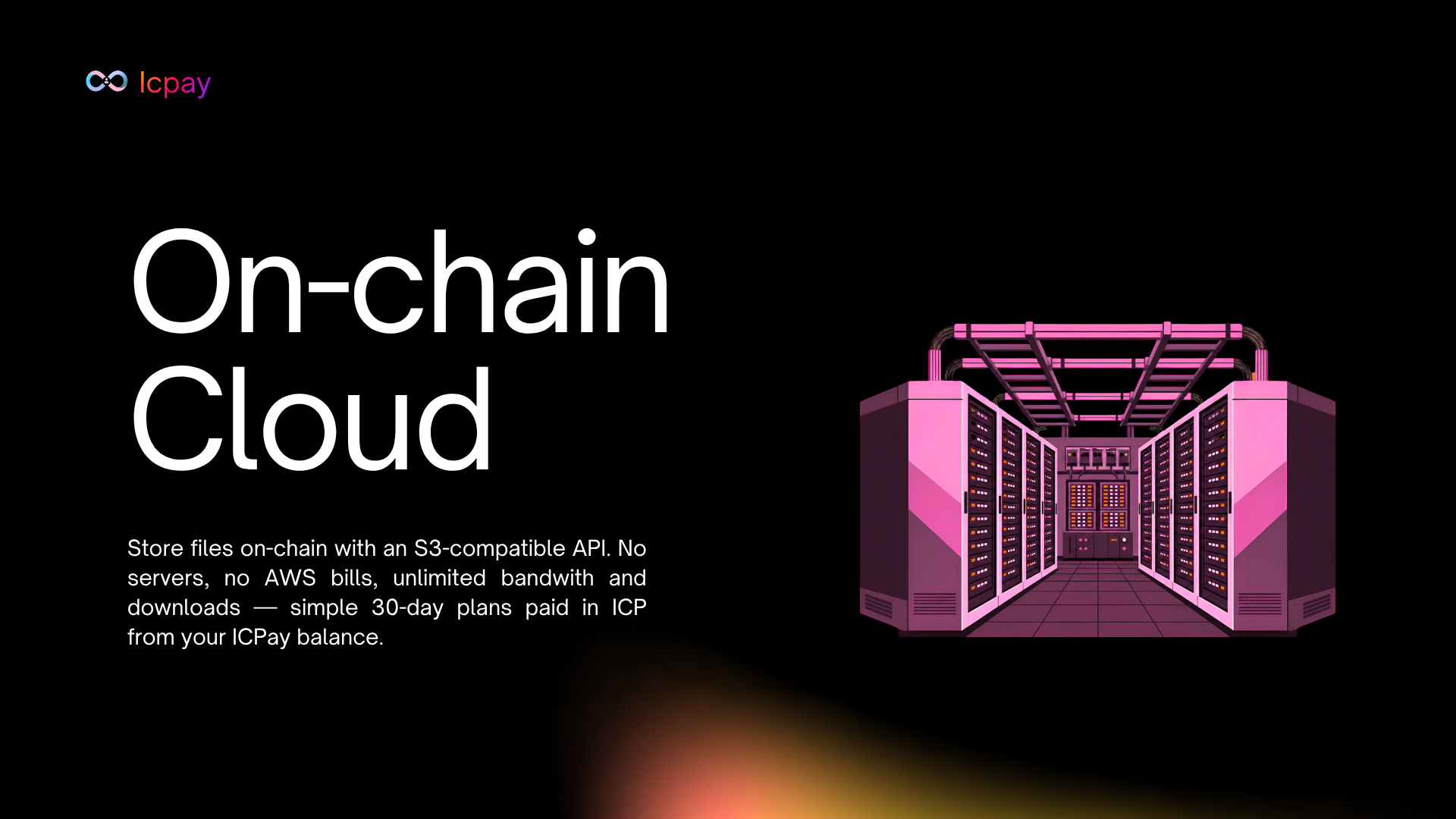
Executive Summary: The Sovereign Cloud Shift
The conversation surrounding decentralized storage has matured beyond speculative token incentives and slow peer-to-peer file sharing protocols. With individual subnets now operating with 2 Tebibytes of fully replicated, tamper-proof memory and total on-chain capacity approaching 100 TiB across dozens of independent subnets, the Internet Computer offers genuine enterprise-grade data residency, instant HTTP streaming, and complete legal insulation from the arbitrary shutdowns, billing disputes, and unilateral terms-of-service modifications that plague centralized hyperscalers.
1. The 2 TiB Architectural Breakthrough: Replicated State vs. Fragmented Storage
To appreciate why the 2 TiB subnet milestone is fundamentally distinct from any prior storage development in the blockchain industry, one must understand the difference between passive, fragmented data archives and active, replicated execution state. In legacy distributed storage networks such as IPFS, Filecoin, or Arweave, files are chopped into discrete cryptographic chunks, pinned to individual third-party storage miners, and retrieved through asynchronous request pipelines that often require external gateway servers or specialized client software.
The Internet Computer operates on an entirely different architectural paradigm: Orthogonal Persistence with Full Subnet State Replication. When data is written to a canister smart contract residing on an ICP subnet, that exact state is replicated across every single independent hardware node machine that participates in the subnet consensus group.
Memory Tiers within an ICP Subnet Node
Standard WebAssembly 32-bit execution heap capped at 4 GiB (or up to 6 GiB under 64-bit Wasm runtime extensions). This volatile memory is utilized for active method execution, temporary computation frames, and immediate call state, clearing whenever a canister upgrade is performed.
Individual canisters can access up to 500 GiB of direct 64-bit stable memory. Managed through zero-copy primitives like ic-stable-structures in Rust, this data bypasses the Wasm heap entirely, surviving code upgrades and system maintenance without costly serialization overhead.
By scaling the collective memory threshold of each subnet to 2 TiB (approximately 2.2 Terabytes), DFINITY has provided the necessary physical runway for massive multi-canister systems. Applications no longer need to fracture their data layer across off-chain AWS S3 buckets simply because an on-chain database exceeded a few gigabytes of storage capacity.
2. Enterprise Cloud Engines: Custom Sovereign Subnets for Global Regulated Industries
While the public Internet Computer network provides an unprecedented substrate for censorship-resistant consumer applications, Fortune 500 corporations, tier-one financial institutions, and European healthcare providers operate under stringent regulatory mandates that prohibit arbitrary global data distribution. Laws such as the European Union's General Data Protection Regulation (GDPR), the NIS2 cybersecurity directive, and the Swiss Federal Act on Data Protection explicitly require companies to maintain verifiable physical control over where their customer records, database snapshots, and telemetry logs are physically stored and processed.
In response to these enterprise demands, DFINITY introduced Enterprise Cloud Engines—a bespoke infrastructure deployment model that allows organizations to spin up dedicated, private ICP subnets customized to their exact legal, geographical, and operational requirements.
Key Capabilities of Enterprise Cloud Engines
Enterprise Tier- •Geographic Hardware Pinning: Enterprises can configure their Cloud Engine cluster to run strictly across verified Tier-3 and Tier-4 data centers within specific jurisdictions, such as exclusively within Switzerland, Germany, or the continental United States.
- •Custom Node Thresholds: Deployments can begin with as few as four dedicated hardware nodes, providing an optimal balance between Byzantine fault-tolerant consensus resilience and infrastructure capital expenditure.
- •Independent Governance Controls: Canister upgrade policies, system administrative permissions, and access control lists can be managed directly by an organization's internal cryptographic multisig or hardware security module (HSM) setups rather than relying on public network governance votes.
The ShadowBridge Dual-Write Migration Protocol
One of the greatest impediments to enterprise cloud modernization is the risk of migration downtime. To eliminate this friction, DFINITY engineered ShadowBridge, a real-time data streaming pipeline that allows enterprises to mirror production workloads running inside Amazon AWS, Google Cloud, or Microsoft Azure directly onto an Internet Computer Cloud Engine simultaneously.
Transactions, files, and state updates are dual-written to both clouds in parallel. Once system administrators verify that state integrity, query response latency, and on-chain verification match or exceed their legacy benchmarks over an extended observation window, production DNS traffic can be cut over to the sovereign on-chain subnet with zero downtime and zero user disruption.
3. The Economic Flywheel: Mission 70 and The Deflationary Burn Mechanism
The prevailing economic model of traditional Web3 infrastructure has historically been plagued by mercenary capital and rampant token dilution. Early decentralized storage protocols routinely issued astronomical annual token inflation to subsidize storage providers, only to watch token values collapse when artificial speculative incentives waned.
The Internet Computer takes a radically opposite approach anchored in real economic utility. Canisters consume computational resources by burning Cycles, which are pegged to the IMF's Special Drawing Rights (SDR) basket (1 Trillion Cycles is permanently calibrated to 1 XDR, or approximately $1.30 USD). This insulates enterprise development budgets from cryptocurrency market volatility; whether the price of ICP is $5 or $500, the physical cost to store a gigabyte of data on-chain remains stable and predictable.
The Mission 70 Revenue Distribution Architecture
Deflationary FlowWith the advent of Enterprise Cloud Engines and the strategic framework known as Mission 70, DFINITY formalized a structural link between real-world enterprise infrastructure billing and open-market token burn mechanics:
Eighty percent of commercial enterprise subscription revenue is paid directly to independent, specialized hardware node operators to finance high-performance data center space, multi-gigabit fiber connections, and continuous enterprise hardware replacement cycles.
The remaining twenty percent of all gross enterprise revenue is programmatically channeled into spot-market buybacks of the native ICP token, followed by immediate and permanent burning. Every enterprise contract signed removes circulating tokens forever.
As global enterprises transition multi-terabyte data stores and high-volume transaction engines onto sovereign subnets, the sheer physical consumption of cycles and the programmatic buyback mechanism create a self-reinforcing, sustainable economic flywheel that rewards long-term network participants without speculative games.
4. Architectural Comparison: Centralized Hyperscalers vs. Web3 Networks vs. ICP
To evaluate how the expanded 2 TiB subnet architecture competes against legacy options, review the structural matrix below comparing centralized cloud giants (AWS S3, Google Cloud Storage), decentralized peer-to-peer storage (Filecoin/IPFS, Arweave), and true on-chain replicated storage on the Internet Computer (icBucket):
| Architecture Attribute | Amazon AWS S3 | Filecoin / IPFS | Arweave (Permaweb) | Internet Computer (icBucket) |
|---|---|---|---|---|
| Consensus & Storage Model | Proprietary centralized server silos | Proof-of-Replication storage deals | Proof-of-Access continuous mining | Fully replicated state across subnet consensus |
| HTTP Web Serving Capability | Requires CloudFront or external reverse proxy | Requires centralized HTTP gateway nodes | Requires centralized HTTP gateway nodes | Native HTTP outcalls & boundary node streaming |
| Subnet / Canister Storage Limit | Petabytes (single corporate jurisdiction) | Variable deal terms (frequently expires) | Append-only perpetual block limits | 2 TiB per subnet / 500 GiB stable memory per canister |
| Outbound Bandwidth (Egress) Fee | Up to $0.09 per GB (severe penalty) | Miner-dependent retrieval negotiations | Gateway bandwidth caps | $0.00 (Zero egress taxes; queries are free) |
| Account Suspension & Deletion Risk | High (automated compliance bot or card failure) | Medium (miner deal lapses if unrenewed) | Low (permanent append-only) | Zero (controlled by cryptographic principal only) |
| Developer Interface | AWS S3 SDK & IAM Access Keys | Lotus CLI & decentralized deal APIs | Arweave JS SDK & wallet keyfiles | Standard S3-compatible REST API & Internet Identity |
5. How icBucket Brings On-Chain Cloud Storage to Everyday Developers
While the technical underpinnings of 2 TiB subnets and threshold cryptography are extraordinarily sophisticated, developers building modern applications should never be forced to write low-level WebAssembly memory management code just to upload an image, backup a PostgreSQL dump, or serve video assets.
This is precisely why icBucket was built. Built on the Internet Computer's high-capacity replicated architecture and integrated directly into the ICPay ecosystem, icBucket packages enterprise-grade on-chain storage into an intuitive, developer-ready platform:
S3-Compatible API
Drop icBucket into existing codebases in place of AWS S3. Use your favorite tools—including the AWS CLI, rclone, boto3 in Python, or the official icpay-bucket SDK in TypeScript—with zero code rewrites.
Zero Egress Bandwidth Taxes
Never fear viral traffic spikes or unexpected cloud bills. Unlike AWS, which penalizes high-growth startups with exorbitant bandwidth transfer fees, icBucket boundary node delivery is completely free of egress taxes.
Internet Identity Custody
Manage storage permissions without fragile API root credentials, passwords, or credit card dependencies. Sign in with biometric passkeys via Internet Identity; your cryptographic principal owns the bucket.
Getting Started with icBucket in Python
Deploying files to on-chain storage requires nothing more than the standard S3 library you already know:
import boto3

# Connect to on-chain icBucket S3 endpoint
s3 = boto3.client(
    "s3",
    endpoint_url="https://cloud.icpay.app",
    aws_access_key_id="YOUR_ICBUCKET_ACCESS_KEY",
    aws_secret_access_key="YOUR_ICBUCKET_SECRET_KEY"
)

# Upload critical business backup directly to on-chain 2 TiB subnet
with open("database_backup_2026.dump", "rb") as file_data:
    s3.put_object(
        Bucket="enterprise-vault",
        Key="backups/database_backup_2026.dump",
        Body=file_data,
        ContentType="application/octet-stream"
    )

print("Encrypted backup stored permanently on-chain with zero cloud vendor lock-in.")
6. Frequently Asked Questions
Does storing 2 TiB on-chain slow down Internet Computer transaction execution?
No. The Internet Computer separates read-only query calls from state-mutating update calls. Query calls execute concurrently on individual node machines within milliseconds without consensus overhead, while update calls utilize deterministic WebAssembly scheduling. Furthermore, stable memory accesses leverage direct memory-mapped I/O rather than serializing data through the Wasm execution stack.
What happens if multiple node machines in a 2 TiB subnet suffer physical power failure?
Internet Computer subnets utilize threshold cryptography and Byzantine fault-tolerant consensus. As long as more than two-thirds of the subnet nodes remain operational, state replication continues uninterrupted without data corruption. When offline nodes recover, they automatically catch up to the current state through state sync protocols verified against threshold signatures.
How does icBucket compare in cost to traditional cloud storage?
Traditional cloud providers charge complex multi-layered invoices: base storage ($0.023/GB/mo), write requests ($0.005/10k), read requests ($0.0004/10k), and egress bandwidth ($0.09/GB). icBucket simplifies this entirely: predictable flat-rate storage starting at 1 GB per ICP (~$5/GB/year) with completely free read bandwidth and zero hidden invoice items.
Can I host public websites, streaming media, and CDN assets directly from icBucket?
Yes. Every file stored inside icBucket can be served directly over standard HTTPS using public CDN URLs (https://cloud.icpay.app/YOUR_BUCKET/YOUR_FILE) or routed through certified on-chain boundary nodes (https://*.raw.icp0.io). Your users view your files in their standard web browser with zero plugins required.
Take Sovereign Control of Your Company's Data Today
Stop living in fear of sudden AWS account suspensions, runaway egress bandwidth invoices, and centralized operator errors. Experience true on-chain S3-compatible cloud storage powered by Internet Computer 2 TiB subnets.
