ICPay v1.7.0 Changelog: Introducing icCron Autonomous Scheduler, Dead Letter Queues & On-Chain Automation
Today, we are thrilled to announce the official release of ICPay v1.7.0. This milestone marks the debut of icCron—the unstoppable, serverless cron layer for Web2 and Web3 workloads—alongside major developer documentation updates and performance polish across the platform.


1. The Headline: icCron Autonomous Scheduler
Scheduled execution has long been one of the weakest links in decentralized applications. Developers building on Web3 protocols previously had to rely on off-chain “keeper bots” running on AWS EC2 or DigitalOcean VPS instances. These bots required plaintext private keys stored in server configuration files, had single points of failure, and frequently crashed due to memory leaks or host reboots.
Meanwhile, Web2 developers deploying Next.js applications on platforms like Vercel have been subjected to an aggressive $20/month per-seat cron tax just to trigger background jobs more frequently than once every 24 hours.
icCron resolves both challenges simultaneously by providing an autonomous, on-chain time engine running directly on the Internet Computer blockchain.
Native 64-bit nanosecond scheduling with zero heartbeat idle cycle burn. Sleeps at 0 cycles between jobs, saving over 99.4% in operational costs.
Cryptographically signed outbound HTTP webhooks that reach any public URL with threshold subnet consensus, verified caller headers, and automatic retries.
2. Under the Hood: Rust Canister Architecture
To maintain strict isolation from ICPay's custodial wallet funds, icCron is implemented as an independent Rust microservice canister located at backend/rust/iccron/.
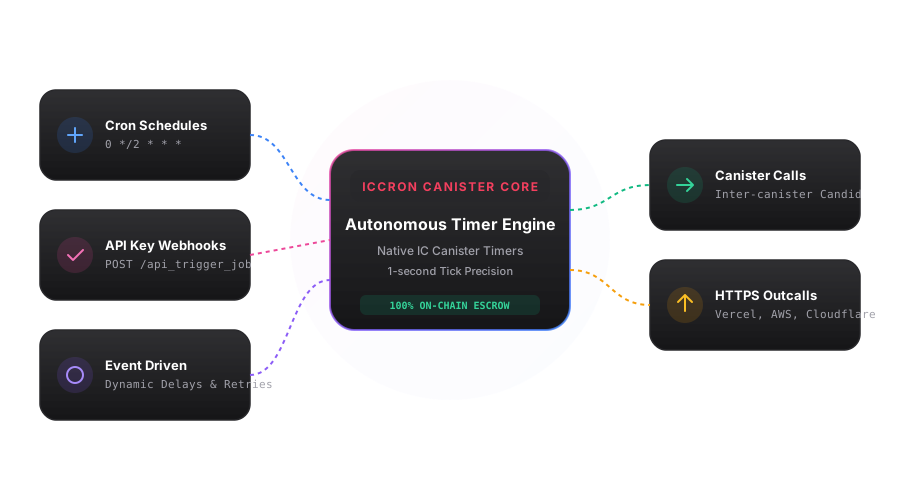
The canister incorporates several architectural breakthroughs:
- O(1) Bitmask Cron Engine: Standard 5-field cron strings are parsed into binary bitmasks (
minutes: u64, hours: u32, days: u32, months: u16, weekdays: u8). Scheduler tick evaluation is calculated using bitwise AND operations with zero regular expression parsing overhead. - Dead Letter Queue (DLQ) & Circuit Breaker: Downstream targets experiencing consecutive HTTP 500 or timeout failures trigger an automatic circuit breaker (
AutoPausedDormant), moving the task to a persistent Dead Letter Queue with full status code and latency diagnostics. - Zero-Key Caller Authentication: Canister-to-canister invocations authenticate using the authentic canister principal (
uzt4z-lp777-77774-qaabq-cai). No private keys, seed phrases, or credentials ever exist to be compromised.
3. Developer Experience & Quickstart Integration
Integrating icCron into your Next.js application, Motoko canister, or AI workflow takes less than 60 seconds:
import { NextRequest, NextResponse } from "next/server";

export async function POST(req: NextRequest) {
  const authHeader = req.headers.get("authorization");
  if (authHeader !== `Bearer ${process.env.ICCRON_SECRET}`) {
    return NextResponse.json({ error: "Unauthorized" }, { status: 401 });
  }

  // Your autonomous logic: sync DB, compound DeFi yields, or trigger emails
  await performScheduledWorkload();
  return NextResponse.json({ ok: true, timestamp: Date.now() });
}
4. Operational Economics: Free Tier & Micro-Credits
We believe scheduled automation should be accessible to solo developers, bootstrapped startups, and enterprise protocols alike:
Free Baseline
60 Runs
Free every month for every user
Micro-Credits
$0.0005
Per execution ($0.50 per 1,000 runs)
Vercel Comparison
98.2% Less
Save $235+/year on hourly jobs
5. ICBucket Documentation & UI Polish
In addition to the icCron release, v1.7.0 delivers notable quality improvements across ICPay:
- Cleaned navigation chrome in ICBucket developer documentation by removing redundant navigation arrows and headers.
- Streamlined clipboard copy UX across API keys and code snippets.
- Maintained 100% multilingual key parity across all 17 supported locales.
Try icCron Today
The public landing page is live at /iccron. Explore the interactive cron syntax sandbox, test real-time ROI savings, and schedule your first autonomous job.
